

Your inner compass.
The best business decision you'll ever make is learning to trust yourself.


This week’s issue is sponsored by Sublime.
Sublime is my favorite tool for creative thinking and cultivating my taste. I use it daily (literally) to collect references, images, quotes, articles, and ideas that move me, which I can later use in my life and work.
Sublime also happens to be my favorite kind of business: built by an inner entrepreneur who openly shares the process in the company newsletter and treats the internal work of building a company as seriously as the external one.
You can try it here and use code RICH to get 20% off a paid subscription.
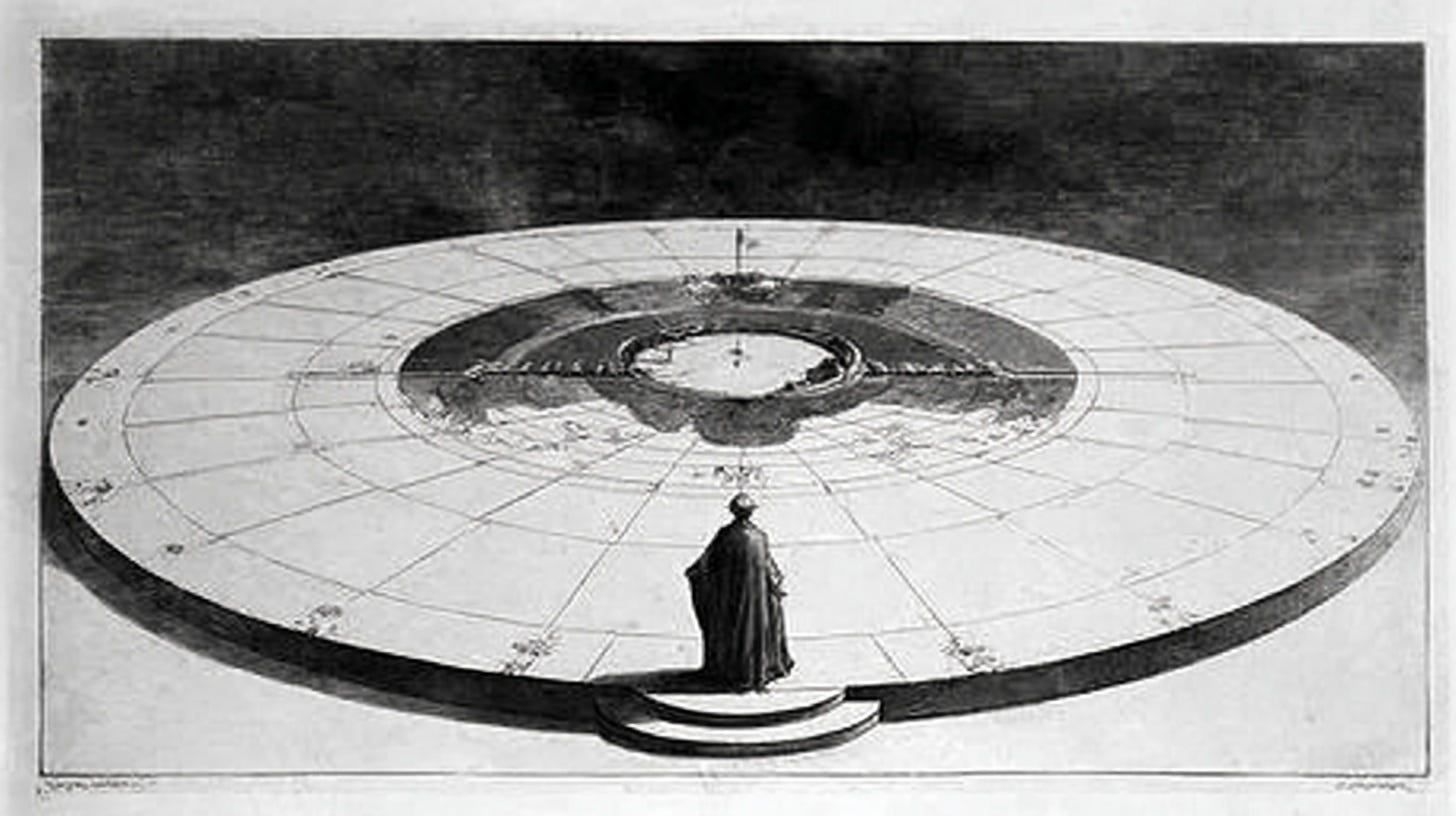
The best business decision you’ll ever make is learning to trust yourself.
Right now you have access to an advisor better than any coach, consultant, or therapist.
You just keep ignoring it.
Pick up any book about high performance, elite entrepreneurs, or the creative act, and you’ll hear them discussing the same thing a million different ways.
Rick Rubin wrote a whole book about it.
It is the source of creativity, great decisions, and truth.
The connection between the body and the mind.
For some, it is their connection to God.
It has many names - your intuition, instinct, or conscience.
I call it your inner compass.
You can use it to make decisions faster (and more accurately), build a business more aligned with what you want, cultivate a higher degree of self-trust, and yes, make a lot more money.
Intuition is knowledge that we feel.

“Intuition is knowledge that we feel but cannot explain.” - Roman Tschäppeler
In Thinking Fast and Slow, Daniel Kahneman describes two systems of thinking, which he calls System 1 and System 2.
System 1 is your intuition.
It’s fast, it’s automatic, and it runs underneath everything you do.
The inner compass.
System 2 is the analytical mind.
It’s slow, deliberate, and logical.
System 1 is incredibly powerful because it harnesses the entire power of your nervous system.
It’s able to detect patterns, risk, and opportunity before the brain can even explain them.
According to a 2025 Caltech study, your sensory systems are able to gather 100 MILLION times more data per second than your analytical mind.
And yet most entrepreneurs have it backwards.
They constantly let their analytical mind lead, and overrule their intuitive mind.
When the brain says no.
“Founders tend to over integrate all the advice… In general you should go with what you feel that you should do. Because your emotional system is a great deal smarter than you give it credit for.” - Joshua Schater
Most entrepreneurs are running System 2 for everything, and it’s running them into the ground.
I call it System 2 Living.
I’ll give you an example:
I had a client who spent four months building a proposal for a partnership she told me felt off from the first conversation.
Four months.
When I asked her why she kept going, she said, “I couldn’t justify saying no. On paper, it made sense.”
Her body said no in five minutes.
Her brain spent four months rationalizing a yes.
The partnership fell apart within six weeks.
That’s the cost of System 2 Living.
Entrepreneurs can feel the intuition (this client is wrong, this price is too low, this project isn’t aligned) but then talk themselves out of it with logic and rationalization.
They based their decisions on what they THINK they should do, rather than what they KNOW they should do.
Don’t get me wrong…
The analytical mind isn’t bad, it’s just not designed to lead.
Ingmar Bergman perfectly describes it in this quote:
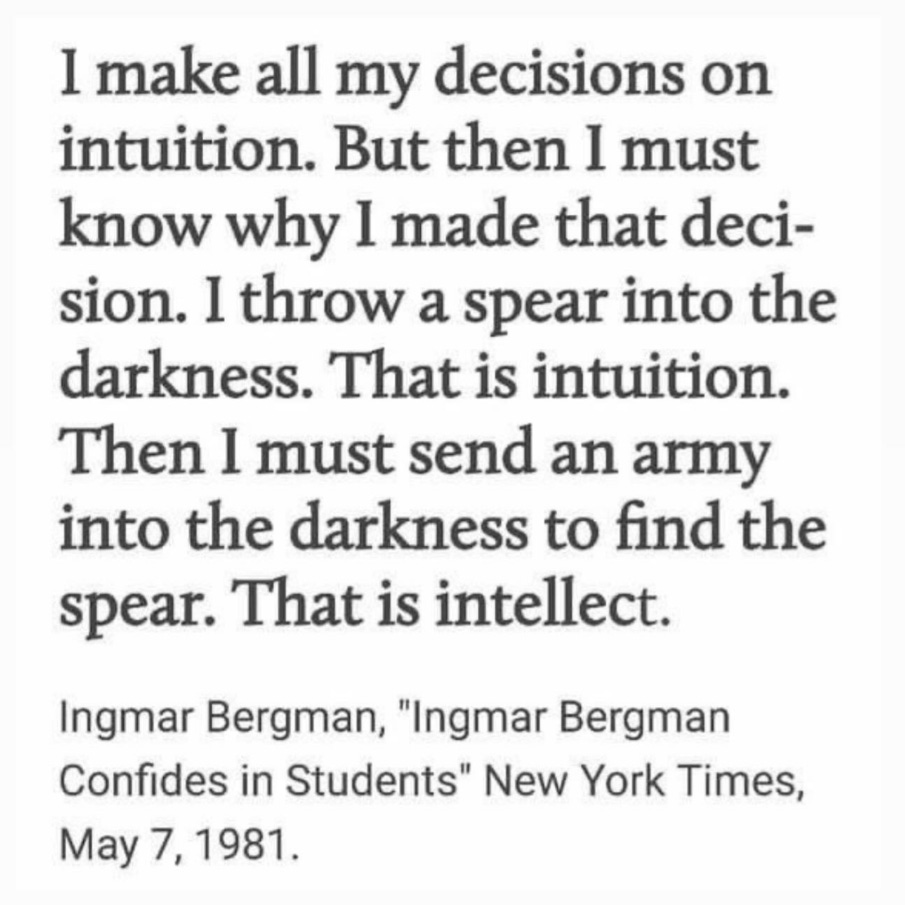
The mind acts as a quality control mechanism for the intuition’s work.
So why do we entrepreneurs ignore our intuition?
Because often, the places it can take us are frightening.
You can fool the world. But you can’t fool yourself.

I do a lot of consulting with entrepreneurs.
Oftentimes, they come to me with a problem, challenge, or issue that they can’t seem to solve.
When I ask them to pause, check in with their body, and tell me what they think they should do - it turns out they nearly always know the answer.
They just don’t like what they know they need to do.
“The beauty of our intuition is that it will not lie to us. The inescapable horror of our intuition is that we may not like what it tells us.” - Catherine Shannon
When we override what we know to be true, it creates serious problems.
Imagine a life where hundreds of times a day, our body is sending us signals about what’s right and what’s wrong for us. (And they’re accurate.)
And yet, rather than listening to those signals, we ignore them.
Multiply that by weeks, months, or years.
It’s why entrepreneurs wake up one day and realize they hate the thing that they’ve built.
Rather than listening to their inner compass, they listened to the market, the gurus, social media, the news, their partner, their friends, anything outside themselves.
Nathaniel Branden says, “Self-esteem is the reputation we acquire with ourselves.”
Overriding our intuition comes with a great cost: our self-esteem and self-trust.
At a retreat I hosted last year, my friend Patrick McAndrew spoke to my clients about this process.
Here’s what he said:
“When entrepreneurs override their internal signals (taking on bad-fit clients, agreeing to unnecessary meetings, saying yes when they feel no), they erode self-trust.
This creates a cycle:
Ignore signals → Overcommit → Push through → Deplete → Lose awareness → Repeat.
Eventually they achieve external success but feel empty.”
The entrepreneurs who ultimately find fulfillment, both internally and externally, understand that the inner compass needs to be part of the process, from day one.
How to access your inner compass.
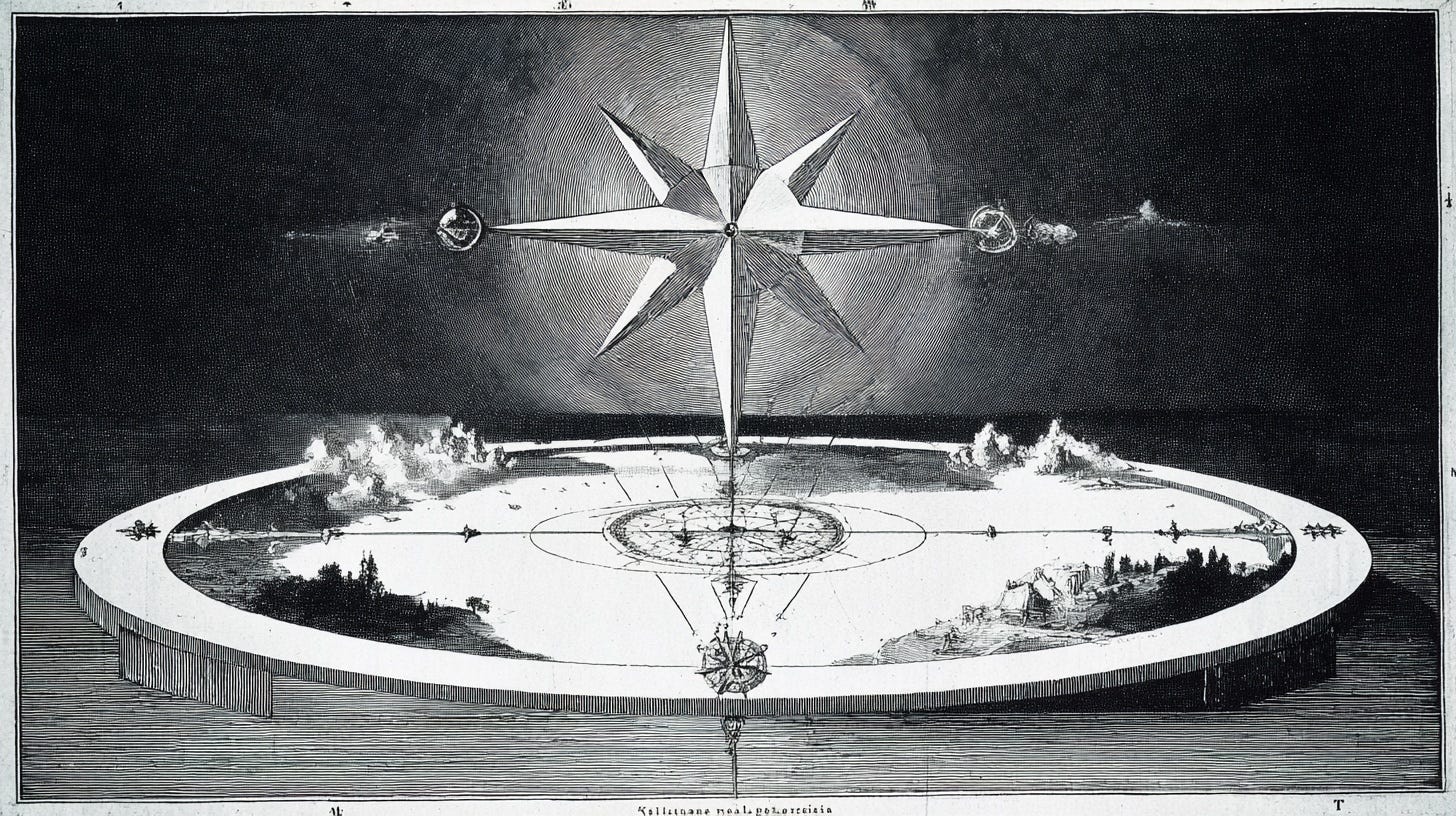
At this point I hope you’re on board that listening to your inner compass is a viable business strategy.
But how do we access our inner compass in a world designed to make us shut it off?
When we bury our intuition through social media, email, Slack, AI, and client demands, there is no space to listen.
And the more your ignore your intuition, the quieter it gets.
So how do we rebuild our relationship with our intuition?
Here are three places to start:
1 - Feel your feelings.

I’ve done a lot of inner work over the past decade.
14 years of twelve-step recovery, meditation, morning pages, IFS therapy, EMDR, neurofeedback, and most recently, Presence Partners (more on that soon).
One of the most surprising things that I noticed in my inner work journey is that intuition can be a physical feeling.
Not only a emotional feeling, but a sensation in the body.
For the longest time, I didn’t understand that emotions were felt in the body.
Emotions were just thoughts that I had about feelings.
This post from Chris Lakin really put words to my experience:

He says when he wasn’t feeling his feelings, “life was in 360p when it could’ve been in 4k.”
He goes on to describe the benefits…
“Decision-making became so easy it feels like there isn’t even a “me” making the choice. I’m more empathetic and see others’ emotions without hesitation. I can tell people to fuck off without wavering. Insecurities can be noticed and released. I’m much more intuitive. I see more. I hear more. 4k feeling enables 4k being.”
These days I often feel my inner compass physically.
I know when things feel “right” and when they don’t.
I can feel the inner signals that tell me to go, to wait, or to stop completely.
This has dramatically impacted both my business and my enjoyment of life.
2- Use your taste as a guide.

“You could say it’s a feeling. An inner voice. A silent whisper that makes you laugh. An energy that enters the room and possesses the body. Call it joy, awe, or elation. When a sense of harmony and fulfillment suddenly prevails.” - Rick Rubin
If you’ve read The Creative Act, it’s abundantly clear that Rick’s superpower is his taste.
In a hilariously iconic interview, Rick admits, “I have no technical ability. And I know nothing about music.”
When asked by Anderson Cooper exactly what he gets paid for, Rubin replied, “The confidence I have in my taste and my ability to express what I feel.”
Rick understands that one of the easiest ways to get in touch with your inner compass is to get in touch with your taste.
Taste comes from an inner knowing.
“I like this.”
“I don’t like this.”
Intuition is powerful because it is a direct channel to what is true to you.
So start asking yourself:
What do I like?
What am I drawn towards?
What resonates?
What do I actually want?
One of the easiest ways to hone your taste is to begin with a practice of cultivation.
By collecting ideas, images, sounds, and video, you are building the habit of discernment.
Recently I’ve been using a tool called Sublime to help me cultivate my taste.
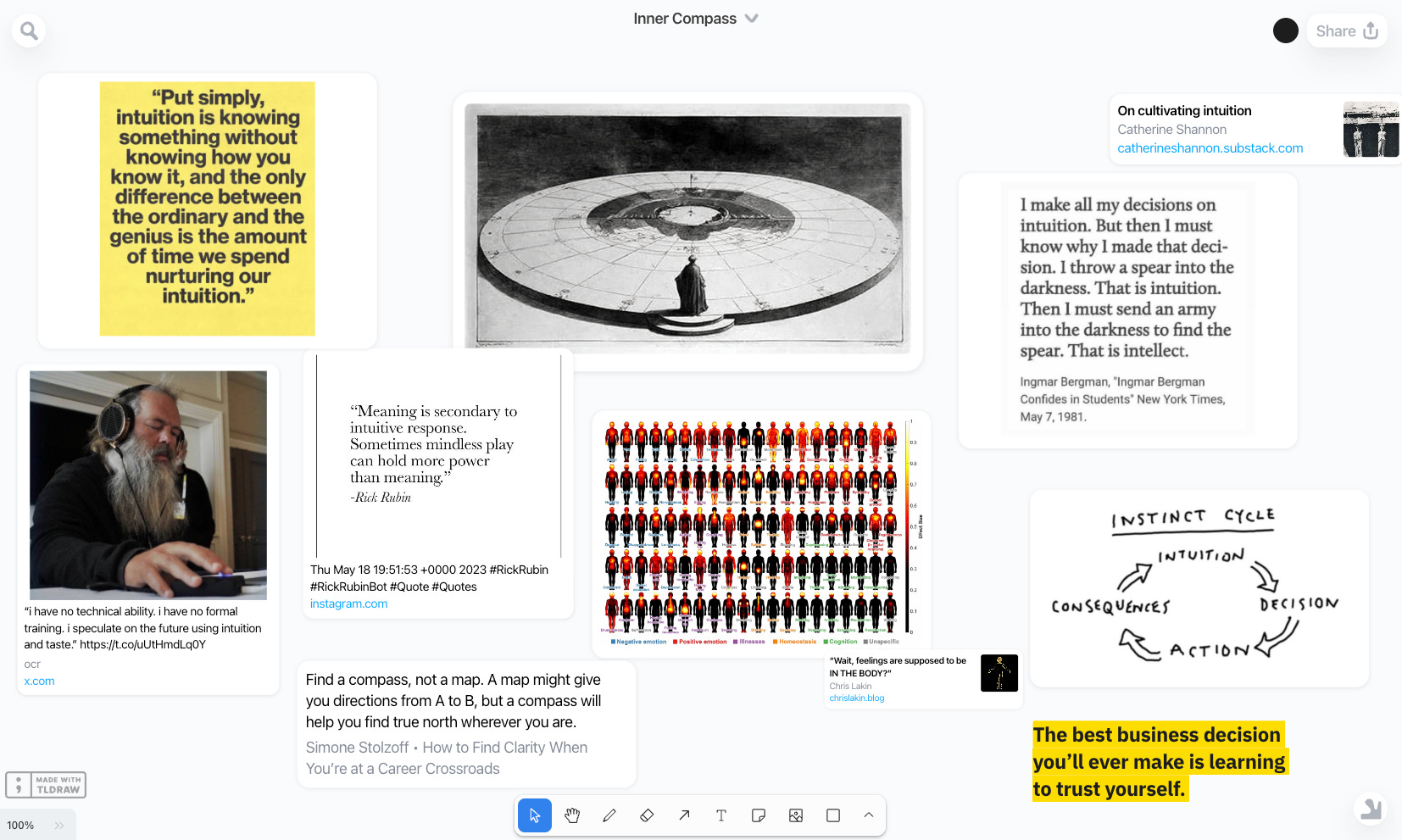
Sublime is a search engine without answers.
Most people go to tools looking for answers, when they really should be looking for more questions.
With Sublime I’m able to discover ideas without compromising my taste.
(including many of the ideas, images, and references I mentioned in this piece.)
P.S. You can get a 20% discount by using code RICH here. 😊
3 - Use the Instinct Cycle to act on your intuition faster.
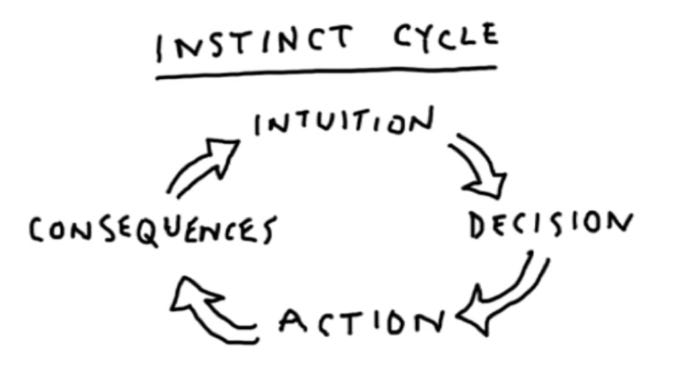
Ultimately, our intuition is nothing without action to follow it.
That’s where Phil Stutz’s tool the “Instinct Cycle“ comes in.
In order to learn to trust our inner compass, we must practice acting on it’s information.
It really doesn’t matter if we are right or wrong.
What matters is we’re building trust and confidence in our intuition.
The “Instinct Cycle” teaches you to compress the time between decision and action.
Here’s how it works:
As you move throughout your days, find every opportunity to make a decision, even if you don’t have enough information—particularly if you don’t have enough information—and take the action with speed. Everything you do is to train this organ to tolerate consequences; the point is to not get it “right.”
In the “Instinct Cycle,” the goal isn’t to be right, it’s to work the cycle the most times.
The more you do this, the less intimidated you’re going to be to take action and the more confidence you will have.
Most entrepreneurs would benefit from making faster decisions.
Especially about decisions that are reversible.
Every decision you’re delaying right now - pricing, hiring, launching, pivoting - has a cost.
Not just the opportunity cost of waiting, but the cost to your confidence.
The more time you let elapse before taking action, the more your self-esteem goes down.
Working the “Instinct Cycle” creates a positive feedback loop, more intuition, more action, more momentum.
Business mirrors life.
Entrepreneurship is abstract - no one hands you a script that explains what you should be doing, where you should be going, or how to do it.
But people have been trained to expect everything spelled out for them.
They want the framework, the formula, the five-step process.
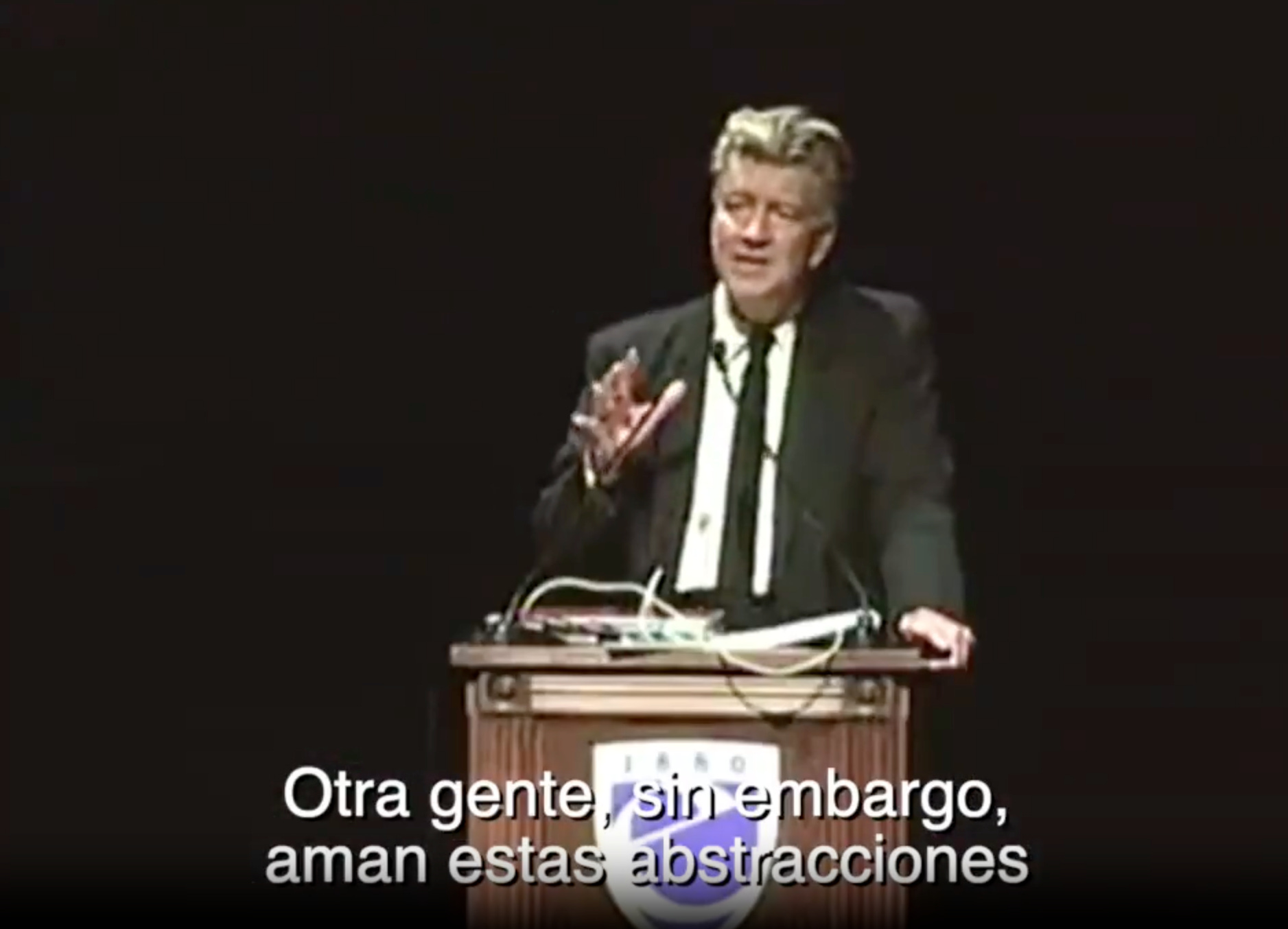
During a speech, filmmaker David Lynch was asked what he thought about films simplifying everything for the audience.
He said:
“Life is filled with abstractions, and the way we make heads or tails of it is through intuition… People get used to film that pretty much explains it 100% and they kind of turn off that beautiful thing of intuition.”
He continues…
“You just feel it and think it, that’s kind of intuition - emotion and thinking together, and make it have a sense to you.”
Entrepreneurs have consumed so much content that they’ve outsourced the very thing that matters most: their inner voice.
And every time they do, the signal gets a little quieter.
That changes today.
Listening to your inner compass means decisions flow through you.
You act with less friction and more alignment.
Your inner compass is the best advisor money can buy, because it only knows what is true to you.
The more you act on your intuition and see the positive results, the more you learn to trust it.
When you can trust your self to guide yourself, it frees up bandwidth, creating more mental clarity and focus.
You stop second-guessing every decision.
You stop looking outside yourself for answers you already have.
You already know what to do.
You just need to trust yourself to do it.
Thanks for reading. It would mean a lot to me if you shared this.
It would mean even more if you implemented it in your life and business.
If you’re curious about working with me, I have two paid offers:
💸 How To Charge More (Waitlist): Live cohort for entrepreneurs who want to scale their business by charging much higher prices. Cohort 2 starts in April.
🤝 Creative Partnership: 1:1 consulting for high-level creative entrepreneurs
+ consultants to looking to hit their first (or next) million in revenue.
That makes a lot of sense. And that situation you mentioned with your client has happened to me too, many times haha.
How do you separate your instinct from the fear of growth and success? Because as humans we’re kind of programmed to hate change, right? Stepping out of our comfort zone can be painful, but necessary.
Been a subscriber of yours for a while now — but this specific piece really stood out! I love this perspective from a business leader to lean in to intuition! I think we have been overly reliant on our analytical brain because it feels "logical".
I also love the amount of work you put into this piece! Appreciate your work, Rich!