

Never lower your prices to win a client.
Will you be happy delivering more for less? Or will you resent the client (and yourself)?


Never lower your prices to win a client.
Yes, I said it.
It devalues your best clients, who happily pay in full.
It rewards bad clients, who will leave for someone cheaper.
There are more than enough people telling you that the market is bad, AI is coming for your job, and you’re lucky to get the work.
I am not one of them.
After working with nearly 600 entrepreneurs, I can tell you one fact:
The vast majority of entrepreneurs are undercharging for the value of your work.
Even those who think they’re charging “high prices.”
You don’t need to lower your prices.
Here’s why:
First of all, the price isn’t even the issue.
Over the past few years, I’ve reviewed hundreds of sales calls for my clients.
When we do a debrief of a call that didn’t close, I’ll ask them:
“What happened on the call? Why do you think they didn’t say yes?”
And they’ll respond with something like:
“Well, I told them the price, and then they said no.”
“I told them the price, and then they asked me for a proposal.”
“I said the price, and then they ghosted me.”
They assume the price lost them the sale.
And it’s a pretty logical conclusion to come to.
In a typical sales conversation, around the 70-80% mark you’re going to start talking about money.

You say the big number, and quite soon after, you’re going to hear a “yes” or a “no.”
The big misconception here is that the price is the CAUSE of the rejection.
I can tell you, that is almost never the case.
And that should actually make you feel better.
Because here’s the truth:
By the time you say the number, the call is already over.
Everything leading up to the price drop is where the “no” happens.
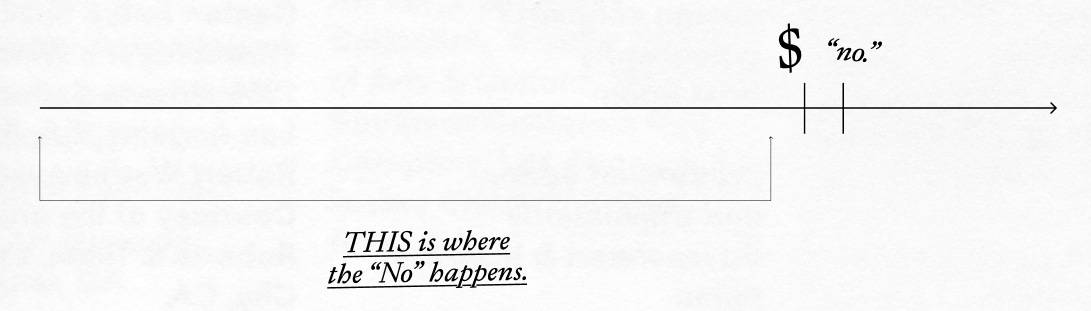
The yes or no is a SYMPTOM of all the things that you did or didn’t do in the first part of the call.
So when you master what happens before the dollar sign, you’re never again going to feel like it comes down to just the price.
People buy when they believe the value of your work is greater than the price.
Rather than ask, “How can I make them see the value?” - most people instead see this play out and think the logical solution is to lower their prices.
Seth Godin explains why this is a huge mistake:
“The problem with the race to the bottom is that you might win.”
Rather than trying to lower your prices, instead you should focus on trying to increase the perceived value of your work in the eyes of the client.
Here’s how to do it:
Understand the deep problems and goals of the person you’re talking to - and articulate them back to them.
Connect your work to the outcomes they actually care about. If you’re selling to businesses, show them how working with you will make them money, save them time, or increase their happiness.
Lead the conversation like an expert. Here’s a hint: If they’re interviewing you on the sales call, they don’t see you as an expert.
Believe in yourself. The client needs to feel that you believe in your work before they believe in your work.
Listen more than you talk.
Give them space to decide. Say the price and shut up. Don’t explain, apologize, or fill the silence. Their brain needs 6-8 seconds to process a big decision.
Finally, detach from the outcome of the call. Focus on what’s in your control. Their decision is up to them.
Rather than worrying about how you can lower your prices to get people to say yes, you should be focusing on how you can articulate the value of the work, so a yes is a no brainer.
So now that that’s out of the way, let’s talk about why you should stand your ground on your pricing.
The price is the price.
You need to understand this truth:
Your prices will cause you to lose clients.
Charging high prices will lose you clients.
Charging low prices will lose you clients.
Which ones would you rather lose?
The cheap, price sensitive clients that come with low rates, or the high quality, value-focused buyers that come with high prices?
I’ll let you decide.
Now that you understand that no matter how you price, you will lose clients, I want you to repeat after me…
“The price is the price. If it’s not a fit, it’s okay.”
Your prices should reflect a fair exchange of value between both parties, where everyone feels like they’re getting a great deal.
Your price is what you believe your work’s value is… to the right person.
If a client is negotiating on price, it’s never about the price.
It’s always about something deeper.
It is either:
1. You have not communicated the value of the work effectively.
2. They are not a fit for the value you provide.
3. They don’t trust you can deliver on your commitments.
4. They are the type of person that always negotiates (beware).
When you realize this, it becomes clear that…
Not everyone is the right client.
There’s no amount of selling that will make the wrong client into the right client.
I can rarely, if ever, think of a situation where a client who negotiated on price from the start ended up magically becoming an incredible client to work with.
The client who negotiates on price will negotiate on everything else:
Your timeline.
Your scope.
Your boundaries.
Will you be happy delivering more for less?
Or will you resent the client (and yourself)?
You need to stop caring whether your clients say yes or no.
That decision is completely out of your control.
Instead you need to focus on what’s within your control:
How you articulate the value of your work.
How thoroughly you conduct a sales conversation.
The level of mastery you have in your craft.
The belief you have in your self and your work.
When you don't strengthen these areas, you start compromising in other ways.
Saying yes to something we know we should have said no to takes a toll on us.
We either become angry at the client for “taking advantage of us,” or we beat ourselves up for folding so easily.
In both cases, what’s at the root of these emotions?
A broken boundary.
Your price is a boundary.

Your price is a boundary.
When you uphold it, you attract clients who respect it.
When you break it, you attract clients who will keep pushing.
Whether you hold those boundaries is a reflection of your self-esteem and your conviction in the value of your work.
And here’s what’s interesting…
The people in our lives (especially our clients) tend to mirror our own self-esteem.
If our prices reflect a lack of conviction in our work’s value, we will attract clients who don’t see the value either.
So once again, it all starts internally.
Think of it like this:
The first sale is always to yourself.
When you believe in your self, you believe in your work.
When you believe in your work, clients feel it.
We spend so much time worrying about the clients we might lose because our prices are too high, and not nearly enough time considering the clients we might never meet because our prices are too low.
At the end of the day, we teach clients how to treat us.
Your prices are lesson one.
💸 How To Charge More (Waitlist) 💸
If you’d like to learn how to charge (much) higher prices and advocate for the value of your work, I can help. I teach a live cohort called How To Charge More. Our second cohort starts in April.
Thanks for reading. It would mean a lot to me if you shared this.
It would mean even more if you implemented it in your life and business.
How much we charge is often a reflection of our own beliefs. I've never regretted charging more but I have regretting charging less every single time I'm tried that route.
I’m glad to read this because am working on my first offer launch in the next 5 weeks.