

You are the bottleneck.
Why you're not doing what you know you should do.


Right now, there is only one thing limiting the growth of your business.
As an entrepreneur, your job is to:
Figure out what it is.
Unblock it.
The process I’m describing is called bottleneck analysis. It’s not new.
It has roots in the Scientific Management principles of the 1900s-1940s.

“The maximum efficiency of any process is limited by the weakest link in the chain.”
- Harrington Emerson, 1911
It works like this:
In any system, there is always one part that is the slowest or most constrained. When you fix the constraint, things flow faster. The faster things flow, the more efficient the system becomes.
Scientific Management is great for machines, assembly lines, and businesses alike.
But for entrepreneurs, a massive piece is missing.
To unblock the constraints holding you and your business back, you need to look inward.
But before we get there, it’s time to go back to school.
How to discover your business bottleneck.
There are some principles that every entrepreneur should know.
Bottleneck analysis is one of them.
It tells you exactly what to focus on to grow your business.
Here’s the process:
Step 1: Get clear on what you want.
You can’t solve a bottleneck without identifying what to improve.
Entrepreneur’s goals tend to fall into three categories: money, time, and happiness.
Decide what you want. It could be:
Double your revenue.
Work 20 hours a week.
Do less of what you hate.
Step 2: Figure out the constraint
Once you know what you want, identify what’s impeding your ability to get it.
The question to ask yourself:
What is the ONE thing that is MOST constraining my ability to get what I want?
Notice that I didn’t say, “What are SOME things.”
Your ability to solve bottlenecks depends most on your ability to identify that number one blockage.
It is also important to consider time and effort in this decision.
Some constraints may unlock a lot if unblocked, but could take years to implement.
We want the constraint that optimizes for the most results with the least effort.
Step 3: Measure it
Once you’ve identified the constraint, you need a system to measure your progress in unblocking it.
If you can’t measure it, you can’t improve it.
Step 4: Unblock it
Finally, devote as much of your discretionary time as possible to fixing it.
If it is TRULY the number one constraint to what you want, anything that isn’t fixing it is procrastination.
Examples
If your goal is to double your business, the bottleneck process might be:
Sales bottleneck → If you improve at sales and your close rate goes from 20% to 40%, you have doubled your business.
Leads bottleneck → If you double the amount of quality leads that you get, your business will double.
Pricing bottleneck → If you double your prices and work with clients that can afford it, your business will double.
Conversion bottleneck → If you improve at copywriting and CRO and get your landing pages to convert 2x, your business will double.
Very logical. Very simple.
The massive problem with bottleneck analysis.
There’s one problem with applying bottleneck analysis to your business...
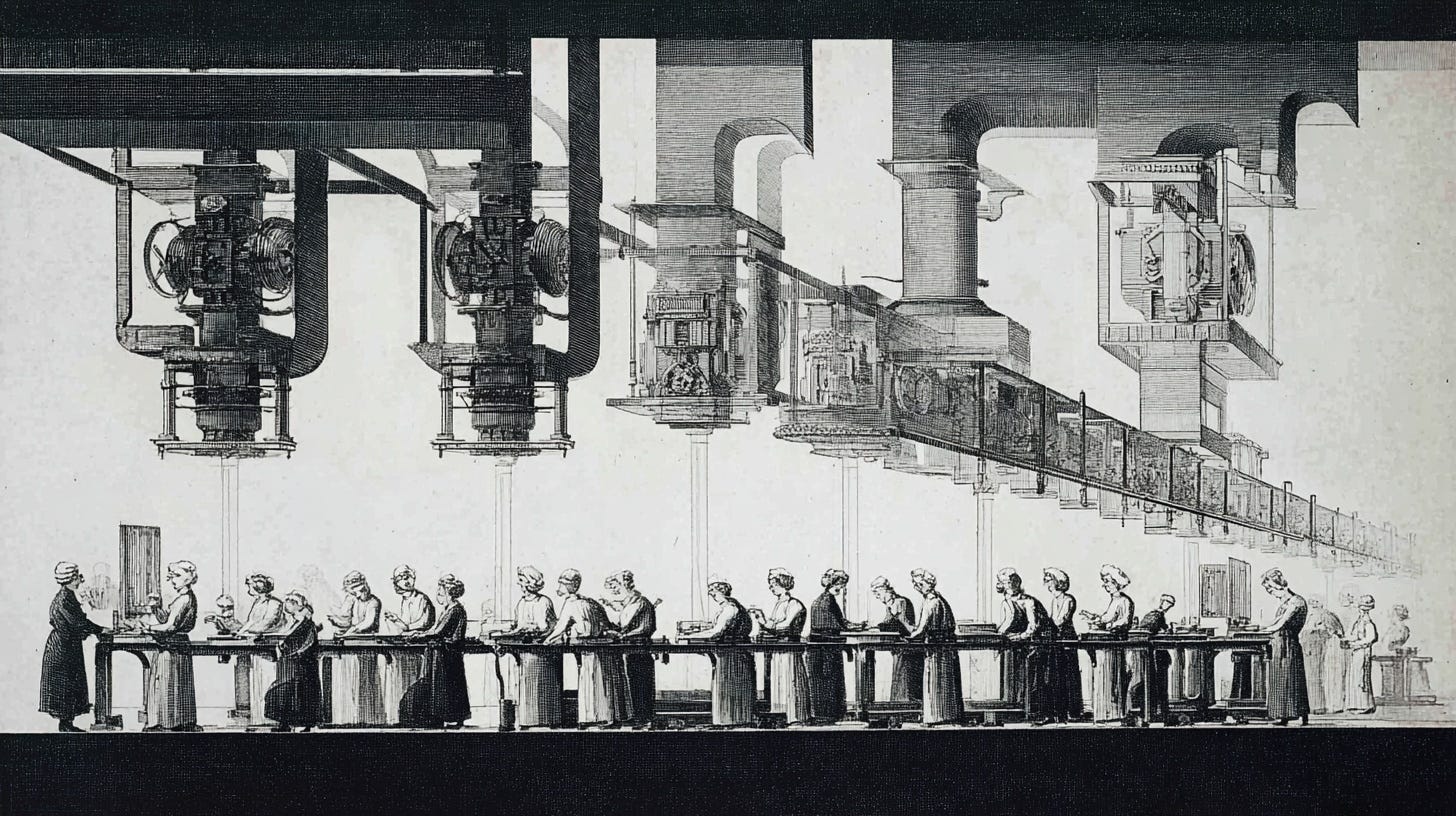
It assumes we’re cogs in a factory.
If you spend enough time working with entrepreneurs, you’ll start to notice a weird pattern:
They are people.
People with emotions, thoughts, fears, and beliefs.
And guess what?
People have issues.
Issues that block them from getting what they want.
In theory, every business bottleneck is an external bottleneck.
There will always be one action or area of focus that will provide the biggest returns for the business system.
In reality, figuring out the external bottleneck is only half the battle.
The truth: You are the bottleneck.
Most businesses are constrained more by the founder’s internal bottlenecks than the external bottlenecks of the business.
Entrepreneurs often “know” exactly what they should do in order to grow their business.
Yet they’re still not doing it.
(Maybe you’re one of them).
There’s more information available on how to grow a business online than ever.
But what there is a massive shortage of?
People with the internal capacity to build great things.
This is because internal bottlenecks are the real limiters for our capacity to take action and do the things that scare us.
How to discover your internal bottleneck.

There’s a reason I taught you how to identify your business bottleneck first.
The external bottlenecks reveal the inner work to be done.
Here are 3 examples of how I helped my clients diagnose their internal bottlenecks.
See if you can figure out the pattern between them.
Example 1: Marketing → Perfectionism
Last week, I spoke with a struggling 6-figure entrepreneur.
External Bottleneck: Marketing
We hopped on the call and he was despondent.
His head was down and his energy was low.
I felt it.
He was frustrated because his product had been stuck at the same sales plateau for the last few years, despite working tirelessly on improving it DAILY.
We got to the heart of the bottleneck when I asked him:
“What percentage of your time are you spending on marketing and sales?”
He responded sheepishly.
Zero.
He didn’t need to keep improving his product. (It’s already amazing.)
There was just a massive misalignment between his goals and actions.
He said he wanted more money (which requires marketing), but his calendar said he wanted a better product.
Internal Bottleneck: Perfectionism
As we drove deeper, it became clear he knew he needed to market.
But an internal block stopped him from doing it.
He knew he needed to start, but since he didn’t have a ton of experience, he knew it would not be perfect initially.
That truth kept him from taking action to solve his problem.
This perfectionism was already playing out in other areas of his life, but it was his business that finally made it click.
The perfectionism that helped him build an incredible product was now blocking him from marketing it (and himself).
Example 2: Sales → Confrontation
Another entrepreneur I work with built an incredible service business but was stuck at the same revenue plateau for months.
External Bottleneck: Sales
Her marketing worked, her product was solid, and clients were happy.
But there was one glaring problem: She was barely closing any sales calls.
Her close rate was a dismal 15%. (Industry average: 35-40%)
We calculated that if she could just double her close rate from 15% to 30%, the business would double overnight.
Same leads, same time investment, double the revenue.
Sidenote: We could have also solved this bottleneck by hiring a salesperson, but it is my belief that the founder MUST be able to sell their product before delegating it. I’ll talk about why in a future issue.
Internal Bottleneck: Fear of Confrontation
When I listened to her sales call recordings, I heard a pattern repeated over and over again.
When we spoke 1:1, she was confident, articulate, and warm, but as soon as she got on a sales call, something would shift.
Her energy would drop.
She would get quiet.
She shut down.
Her lack of conviction and confidence meant that:
She would state the price and immediately start negotiating against herself.
The client would raise an objection and she would immediately fold.
She would end calls with “I’ll send you a proposal.”
She believed asking for a clear yes or no was somehow wrong.
This stemmed from a deep belief that confrontation was dangerous and that good people don’t pressure others to buy.
In her mind, being direct about money felt “pushy” or “aggressive.”
The problem?
Clients want to work with someone who is confident that they can help them.
The irony?
Her internal blockage wasn’t helping anyone.
It turned away clients she could truly help and her business stayed stuck.
Example 3: Complexity → People Pleasing
Recently, I worked with a brilliant entrepreneur who couldn’t say no.
Business Bottleneck: Complexity
When we dug in, the external bottleneck was clear - this entrepreneur was overwhelmed by the many things he had said yes to:
Too many clients.
The wrong team.
10+ offers.
If the business was simplified, he could double down on finding and serving more of his highest profit clients.
He knew about this problem for years.
But didn’t take action.
Internal Bottleneck: People Pleasing
The underlying internal bottleneck was a serious issue with conflict.
As a people-pleaser, he only felt comfortable when there was zero conflict in his business.
His sensitivity to the needs of others served him extremely well initially.
Clients were always well taken care of.
Problems were avoided at all costs.
Then it stopped working.
Whenever a conflict occurred, his nervous system felt like it was on fire.
He would shut down completely and take a whole day to recover.
As a result, he developed a habit of making decisions to avoid conflict.
This led to a collection of clients, offers, and people that he didn’t say “No” to.
In business, conflict and confrontation are inevitable.
You can’t avoid firing employees.
You can’t avoid confronting unhappy clients.
You can’t avoid difficult conversations.
Not building the capacity to handle conflict (by avoiding it) ultimately hurt him (and the business).
The external reveals the internal.

All three examples reveal the same truth:
The business bottleneck reveals the internal work to be done.
The business reveals the bottleneck.
The bottleneck reveals the blockage.
The blockage reveals the path.
Moving through these internal blockages is an ongoing messy process.
Often there are deep wounds that need to be addressed.
But if we want the business to grow, we have to grow.
Working on yourself does not mean not working.
It means developing the internal capacity to take the actions your business requires of you.
Over time, we find it easier to take actions we previously avoided, minimized, or sabotaged, even though we knew they needed to be done.
The leverage is the internal work.

Once you grasp the basic principles, you realize that most of business is a game in between our ears.
Entrepreneurship illuminates a path to the parts of ourselves that are underdeveloped.
Bottleneck analysis shows us that a system will only grow as big as its largest constraint.
The internal work shows us that our freedom will always be limited by the greatest fear that keeps us from taking action.
The external bottlenecks reveal the inner work to be done.
The truest sign of the internal work “working” is whether your actions reflect the person you are trying to become.
When you address the external, the business grows.
When you address the internal, everything grows.
Thanks for reading. It would mean a lot to me if you shared this.
It would mean even more if you implemented it.
If you’re interested in working closely with me, watch this.
Really enjoy this new substack Rich and your creativity.
“Entrepreneurship illuminates a path to the parts of ourselves that are underdeveloped”. Love this. People I speak to often say they don’t know what they don’t know, but if they pay attention to external bottlenecks and internal resistance the road becomes pretty clear.